
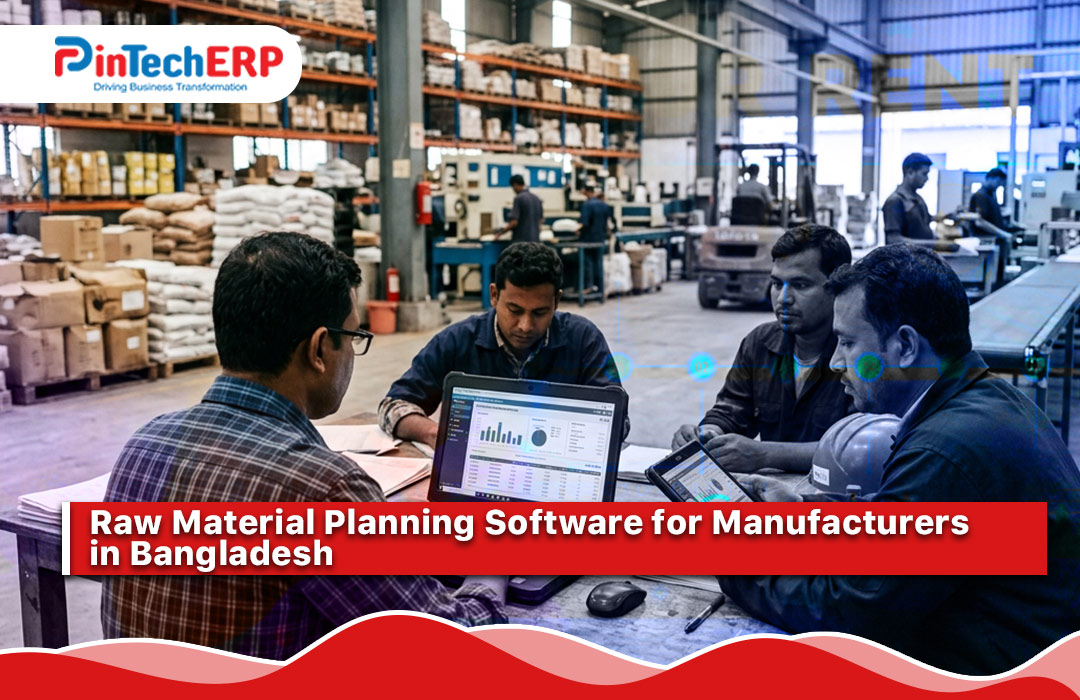
Bangladesh has firmly established itself as a manufacturing hub, from garments and textiles to plastics, food processing, pharmaceuticals, and light engineering. As factories scale production to meet growing domestic and export demand, one operational challenge consistently separates efficient manufacturers from struggling ones: raw material planning.
Poor raw material planning leads to production stoppages, excess inventory tying up working capital, missed delivery deadlines, and strained supplier relationships. On the other hand, manufacturers who get raw material planning right consistently run leaner operations, fulfill orders on time, and protect their profit margins even when raw material prices fluctuate.
This is where raw material planning software, built into a proper ERP system, becomes essential. In this article, we’ll break down what raw material planning software does, why it matters so much for manufacturers in Bangladesh, the features that actually move the needle, and how to choose the right solution.
What Is Raw Material Planning Software?
Raw material planning software is a system that helps manufacturers forecast, procure, track, and allocate the raw materials needed for production. Rather than relying on manual stock counts, gut-feel reordering, or scattered spreadsheets across departments, this software connects production planning directly with inventory and procurement.
At its core, raw material planning software typically handles:
- Demand forecasting based on sales orders and production schedules
- Material Requirement Planning (MRP) calculations
- Automated purchase order generation
- Supplier and lead-time tracking
- Inventory level monitoring across warehouses
- Batch and lot tracking for quality control
- Wastage and yield analysis
When this functionality is embedded within a full ERP system, it doesn’t operate in isolation — it’s connected to sales, finance, and production data in real time, which is where the real value comes from.
Why Raw Material Planning Is Critical for Bangladeshi Manufacturers
1. Volatile Import Dependency
A large portion of raw materials used by Bangladeshi manufacturers — especially in textiles, plastics, and pharmaceuticals — are imported. Currency fluctuations, shipping delays, and customs clearance times can all disrupt supply. Manufacturers need software that can model lead times realistically and trigger reorders early enough to absorb these delays.
2. Thin Margins in Competitive Export Sectors
Industries like RMG (ready-made garments) operate on tight margins where even small amounts of raw material wastage or overstocking can significantly affect profitability. Precise planning helps manufacturers order exactly what’s needed, reducing both stockouts and excess inventory.
3. Seasonal and Order-Driven Demand
Many Bangladeshi manufacturers work on a mix of bulk export orders and seasonal domestic demand. Without proper planning tools, it’s difficult to align raw material procurement with these fluctuating and often unpredictable order patterns.
4. Multiple Production Lines and SKUs
Manufacturers producing multiple product variants — different fabric blends, packaging sizes, or formulations — need software that can handle complex Bills of Materials (BOM) and calculate exact raw material requirements per variant, rather than relying on rough estimates.
5. Manual Processes Still Common in Many Factories
Despite growth in the sector, many mid-sized factories in Bangladesh still rely on manual stock registers or basic spreadsheets for raw material tracking. This creates blind spots — factory managers often only discover a shortage when production is already halted, rather than days or weeks in advance.
Key Features to Look for in Raw Material Planning Software
Accurate Bill of Materials (BOM) Management
The software should let you define detailed BOMs for every product, including sub-assemblies and variants, so that raw material needs are calculated precisely rather than estimated.
Material Requirement Planning (MRP) Engine
A proper MRP engine calculates exactly what raw materials are needed, when, and in what quantity, based on confirmed sales orders, forecasts, and existing inventory levels.
Automated Purchase Order Generation
Once shortages are identified, the system should be able to automatically generate purchase orders or at least flag recommended orders for approval, reducing manual procurement work.
Supplier Management and Lead Time Tracking
Tracking supplier reliability, historical lead times, and pricing trends helps planners make smarter sourcing decisions and avoid last-minute scrambling.
Real-Time Inventory Visibility
Raw material stock levels should be visible in real time across all warehouses or storage locations, not updated only at the end of the day or week.
Batch and Lot Traceability
For industries like pharmaceuticals and food processing, being able to trace raw material batches through to finished goods is often a compliance requirement, not just a convenience.
Wastage and Yield Reporting
Understanding how much raw material is lost to wastage versus how much converts into finished product helps identify inefficiencies on the production floor.
Integration with Production and Finance
Raw material planning shouldn’t exist in a silo. It needs to connect with production scheduling on one side and financial reporting (cost of goods, inventory valuation) on the other.
The Cost of Poor Raw Material Planning
Manufacturers who continue relying on manual or fragmented planning processes often face recurring problems:
- Production stoppages because raw materials weren’t ordered in time
- Overstocking that ties up working capital in materials that sit unused for months
- Inaccurate costing because raw material usage isn’t tracked precisely against production output
- Poor supplier negotiation position due to lack of historical purchasing data
- Compliance risks in regulated industries where batch traceability is required but not properly documented
Each of these issues has a direct financial cost, whether through lost sales, wasted inventory, or inefficient use of capital. For manufacturers operating on already tight margins, these inefficiencies can be the difference between a profitable quarter and a loss-making one.
How ERP-Based Raw Material Planning Changes the Picture
A standalone spreadsheet or basic inventory tool can help track raw materials at a surface level, but it can’t connect that data to actual production demand or financial outcomes. This is why more manufacturers in Bangladesh are moving toward full ERP systems with built-in raw material planning modules.
An ERP system ties together:
- Sales orders and forecasts, which drive material demand
- Production schedules, which determine when materials are actually consumed
- Inventory data, which shows what’s currently available
- Procurement, which handles the sourcing and purchasing process
- Finance, which tracks the cost implications of every material decision
When these functions are unified, raw material planning becomes proactive instead of reactive. Planners can see shortages weeks in advance, factory managers can trust that materials will arrive on schedule, and finance teams get accurate, real-time visibility into inventory value and cost of goods sold.
For manufacturers exploring what a connected system looks like in practice, this overview of manufacturing ERP software explains how production planning, inventory, and raw material management can work together within a single platform rather than as disconnected tools.
Why PinTech ERP Fits Bangladeshi Manufacturers
PinTech ERP has been designed with an understanding of how manufacturing actually operates in Bangladesh — from import-heavy supply chains to order-driven production cycles. Key strengths include:
- Localized planning logic that accounts for realistic import lead times and local supplier dynamics
- Flexible BOM and MRP tools that handle multiple product variants and production complexity
- Real-time inventory tracking across single or multiple factory locations
- Integrated procurement workflows that reduce manual purchase order creation
- Connected financial reporting so raw material costs flow directly into overall business accounting
- Local implementation support to ensure the system fits existing factory workflows rather than forcing disruptive changes
How to Choose the Right Raw Material Planning Software
When evaluating options, manufacturers should consider:
- Complexity of your BOMs — If you produce multiple variants or use sub-assemblies, ensure the software can handle multi-level BOMs accurately.
- Import dependency — Look for tools that let you model realistic supplier lead times, especially for imported raw materials.
- Integration needs — Raw material planning should connect with production, inventory, and accounting rather than operating as an isolated tool.
- Traceability requirements — If you’re in a regulated industry, confirm the system supports batch and lot tracking.
- Scalability — Choose software that can grow with your production volume and product range, not just your current setup.
Final Thoughts
Raw material planning isn’t just a back-office function — it directly affects production continuity, cost control, and customer satisfaction. As Bangladesh’s manufacturing sector continues to grow and compete globally, manufacturers who rely on manual tracking or disconnected tools will increasingly struggle to keep pace with more efficient, data-driven competitors.
Investing in proper raw material planning software, embedded within a full ERP system, gives manufacturers the visibility and control needed to plan procurement accurately, avoid costly production delays, and protect margins even as raw material costs and supply chains remain unpredictable. A platform like PinTech ERP, built with local manufacturing realities in mind, offers a practical path toward that kind of operational control.