
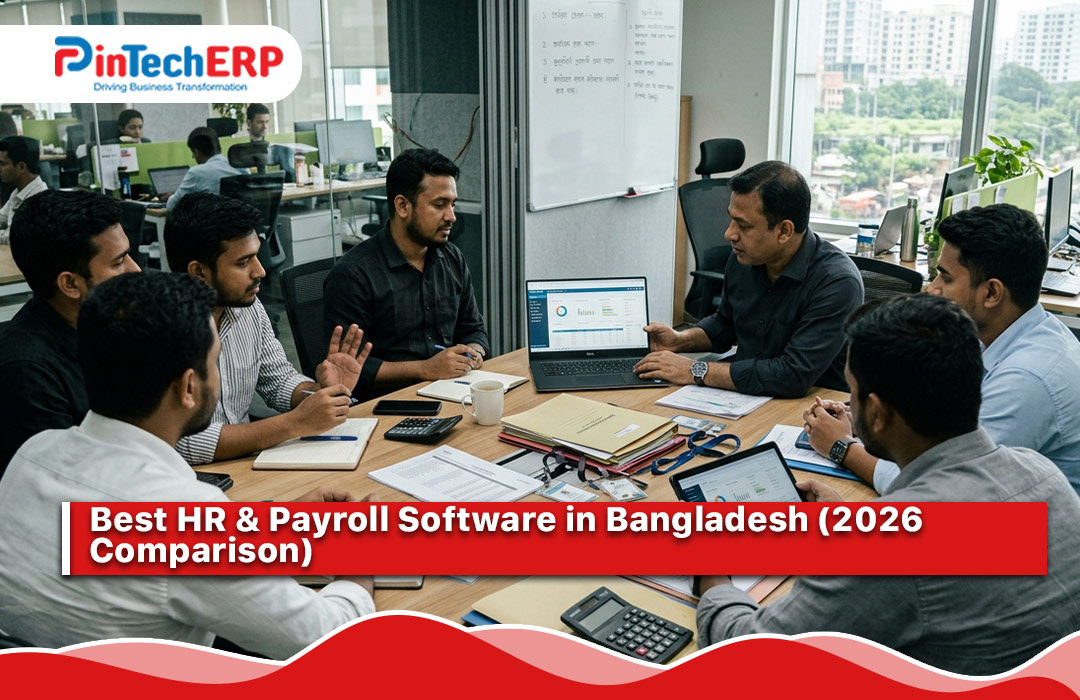
Managing people is still the hardest part of running a business in Bangladesh — and payroll is the part that can’t afford to go wrong. A single miscalculated overtime figure, a missed provident fund deduction, or a delayed salary disbursement can damage trust with your employees overnight. That’s why more companies, from RMG factories to fintech startups, are replacing spreadsheets and manual attendance registers with dedicated HR & Payroll software.
In 2026, the Bangladeshi market has more HR software options than ever before. Some are built specifically for local labor law and tax structures, others are global platforms adapted for the region, and a growing number are modules inside larger ERP systems that connect HR data directly to accounting, inventory, and operations. Choosing the right one depends less on which software has the longest feature list and more on which one actually fits how your business works.
This guide breaks down what to look for, compares the leading categories of HR & payroll solutions available in Bangladesh this year, and explains where an ERP-integrated approach — like PinTech ERP’s HR and payroll module — has a real advantage over standalone HR tools.
Why HR & Payroll Software Matters More Than Ever in 2026
Bangladesh’s labor market has grown more complex, not less. Multi-branch operations, remote and hybrid work, biometric attendance requirements, provident fund and gratuity calculations, and frequent changes to tax slabs all add layers of complexity that manual processes simply cannot handle reliably at scale.
Digital HR adoption in Bangladesh has accelerated sharply in the last few years as companies look for measurable gains: fewer payroll errors, faster onboarding, and less time spent on repetitive administrative work. The businesses that have moved earliest to structured HR systems are typically the ones best able to scale headcount without scaling HR headaches proportionally.
What to Look for in HR & Payroll Software in Bangladesh
Before comparing specific platforms, it helps to know which features actually move the needle for a Bangladeshi business:
1. Local compliance built in. Income tax slabs, provident fund rules, gratuity calculations, and labor law requirements in Bangladesh are specific enough that a generic global tool often needs heavy customization. Software built for or adapted to the local market saves you that overhead.
2. Biometric and remote attendance support. With multi-shift factory floors and distributed office teams both common, the software needs to handle fingerprint devices, GPS-based mobile check-ins, and manual overrides without creating reconciliation headaches.
3. Automated payroll processing. Salary, overtime, deductions, bonuses, and final settlements should calculate automatically from attendance and leave data — not get re-entered by hand every month.
4. Employee self-service. Letting employees view payslips, apply for leave, and check attendance themselves removes a huge volume of repetitive queries from HR’s plate.
5. Scalability across branches. If you expect to open new offices or factory units, the system should support multi-branch structures without needing a separate license or a rebuild.
6. Integration with the rest of the business. This is where many standalone HR tools fall short. Payroll doesn’t exist in isolation — it needs to reflect in your accounting ledgers, cost centers, and financial reports. A system that requires manual export/import between HR and finance software reintroduces the exact errors you were trying to eliminate.
The Bangladeshi HR & Payroll Software Landscape in 2026
The market roughly splits into three categories:
Standalone local HR platforms. A number of homegrown HR and payroll tools have built strong followings by focusing tightly on attendance, leave, and salary processing for Bangladeshi SMEs and RMG-sector companies. These tools are often praised for being straightforward and budget-friendly, and several have built solid track records with garment and manufacturing clients specifically because they handle high-volume, multi-shift payroll reasonably well.
Cloud-based HR suites with broader ambitions. Several newer entrants position themselves as complete workforce management platforms — covering recruitment, onboarding, performance reviews, and payroll under one roof, often with mobile apps and self-service portals aimed at fast-growing startups and mid-sized enterprises.
Global open-source platforms adapted locally. Some businesses adopt internationally known HR frameworks and customize the payroll and compliance layer for Bangladesh. These offer flexibility and a large ecosystem of add-ons, but often require a technical partner to configure correctly for local tax and labor rules.
Each of these categories solves the HR problem reasonably well in isolation. The recurring gap across almost all of them, though, is what happens after payroll is processed — when that data needs to reach your accounting books, your department budgets, and your financial statements.
Where ERP-Integrated HR & Payroll Pulls Ahead
This is the core distinction worth understanding before you commit to a platform. A standalone HR tool, however well designed, still leaves you with two systems: one for people, one for money. Someone has to keep them in sync.
PinTech ERP takes a different approach with its dedicated HR and payroll module, PinPMS, which is built directly into the same ERP environment as accounting, inventory, and operations. That means:
- Salary processing automatically posts the correct journal entries to your general ledger — no manual re-entry between HR and finance.
- Attendance, leave, and overtime data flow directly into payroll calculations without needing a bridge tool.
- Department-wise and branch-wise payroll costs reflect immediately in your financial reports, giving management real-time visibility into labor cost as a percentage of revenue.
- Employee self-service, biometric attendance integration, and automated tax/PF calculations are handled within the same platform your finance team already uses.
For businesses that have outgrown spreadsheets but don’t want to end up managing three or four disconnected software subscriptions, this integrated model removes an entire category of reconciliation work. It’s also a natural fit for industries where HR and operational data are tightly linked — including sectors PinTech ERP already serves closely, such as its work supporting ERP software for real estate companies, where project-based staffing, site-wise payroll, and commission structures all need to tie back cleanly into the same financial system.
How to Choose the Right Fit for Your Business
There’s no single “best” HR and payroll software for every company in Bangladesh — the right choice depends on your size, industry, and how tightly you need HR data connected to the rest of your business.
- Small teams with simple payroll needs may do fine with a lightweight, standalone attendance and payroll tool.
- Manufacturing and RMG-sector companies with multi-shift, high-headcount payroll should prioritize software with strong biometric attendance handling and bulk processing speed.
- Growing mid-sized and enterprise businesses that need payroll numbers to flow directly into financial reporting — without a finance team re-keying data every month — are usually better served by an ERP-integrated HR module.
Before signing a contract, it’s worth asking any vendor three questions: Does this system handle Bangladeshi tax and provident fund rules out of the box? Can it scale to additional branches without a costly rebuild? And critically — does payroll data connect to your accounting system automatically, or will someone need to move numbers between two platforms every pay cycle?
Final Thoughts
The HR and payroll software market in Bangladesh has matured significantly heading into 2026, giving businesses far more genuine choice than they had even a couple of years ago. Standalone HR tools remain a reasonable option for companies that just need attendance and salary processing handled cleanly. But for businesses that want their people costs, department budgets, and financial statements to stay in sync automatically, an ERP-integrated approach removes the manual bridge-work that standalone tools leave behind.
If you’re evaluating options for your business, it’s worth looking at how PinTech ERP’s PinPMS module handles payroll, attendance, and compliance alongside the rest of your operations — so your HR data isn’t just accurate, it’s actually connected to how your business runs.