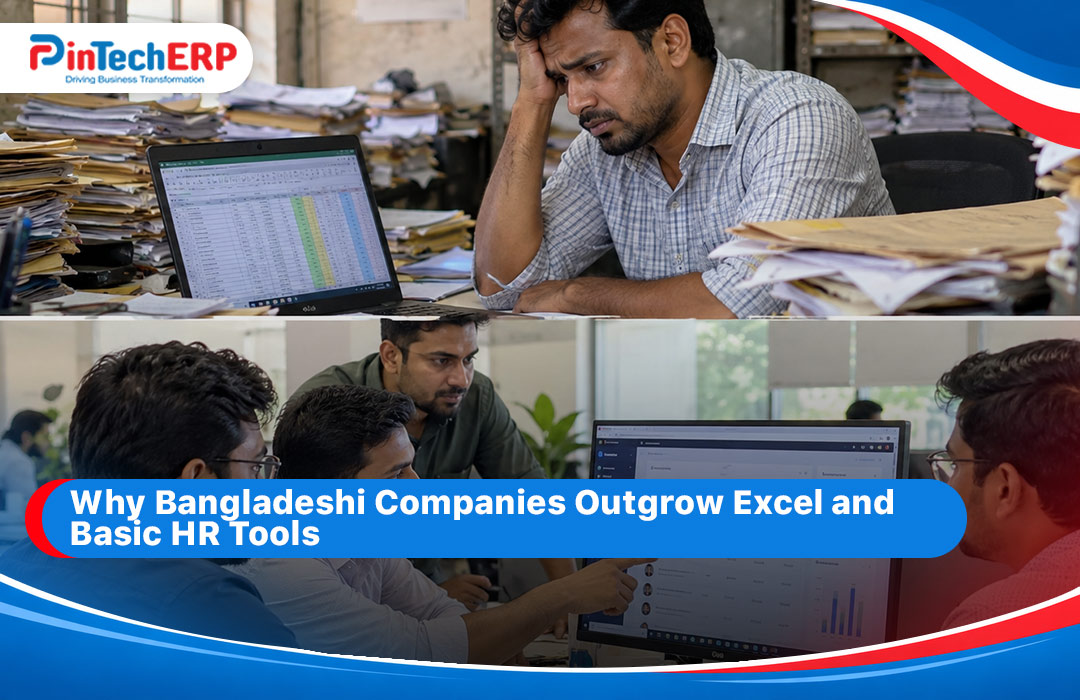
Without an ERP system, most businesses face the same problems: data in many places, numbers that do not match, slow reports, stock errors, late collections and heavy dependence on a few people. These problems stay small while the business is small. As you add customers, branches or staff, they grow fast and begin to cost real money.
This guide lists the most common problems, explains why they happen and gives a short self-check so you can judge for yourself.
Why these problems appear
Most companies start with simple tools: a notebook, Excel, a basic accounting package, WhatsApp. These work well at first. But each tool holds one piece of the business, and they do not talk to each other. People carry data between them by hand. Every handover is a chance for delay and error.
The issue is not that your team is careless. It is that the tools are separate.
15 common problems
1. Numbers do not match. Sales says one number, accounts says another, the store says a third. Meetings turn into arguments about whose sheet is right.
2. Stock never matches the shelf. System stock and physical stock differ, and nobody can say why. Counts take days. See inventory management software.
3. Reports arrive late. The owner waits a week or more for a profit or sales report. By then, the moment to act has passed.
4. Month end is a crisis. Accounts staff work late to chase data, fix errors and prepare VAT. See accounting software in Bangladesh.
5. Double entry everywhere. A sale is typed in the invoice file, the stock sheet, the ledger and the customer list. Every copy can go wrong.
6. Customer dues are hard to see. Nobody knows exactly who owes what and for how long. Collection depends on memory.
7. Credit risk is unmanaged. Sales staff give goods on credit without limits. One big bad debt hurts cash flow.
8. Purchase decisions are guesses. You run out of fast items and overbuy slow ones. See supply chain management software.
9. True cost and profit are unknown. You know total sales, but not which product, customer or project earns money. Import costs are not included. See ERP for import-export.
10. Payroll is slow and disputed. Attendance, leave and overtime come from several places, and salary sheets take days. See HR software in Bangladesh.
11. Wastage and leakage go unseen. Material, time and money disappear, and there is no trail to find where.
12. Too much depends on a few people. One accountant or store keeper holds the knowledge. If they leave, the business is stuck.
13. Branches work separately. Each branch has its own records, and head office sees a late summary. See ERP for multi-branch business.
14. Compliance feels risky. VAT, tax and audit records are scattered, and every audit is stressful.
15. Growth feels like chaos. More orders mean more mistakes, not more profit.
How these problems look in different industries
Real estate: double bookings, missed installments and unknown project cost. See real estate ERP.
Factories: wrong material plans, high wastage and late costing. See manufacturing ERP.
Garments and footwear: order delays, consumption control and shipment pressure. See garments ERP and footwear ERP.
Trading and distribution: stock mismatch, credit risk and cheque tracking. See ERP for trading business.
Retail: stock by outlet, cash mismatch and lost sales. See POS software.
Service firms: unbilled time and late invoices. See ERP for service businesses.
The hidden cost of these problems
The cost does not appear as one line in your books. It hides in many places:
- Staff hours spent on re-typing and checking
- Stock lost, expired or sitting idle
- Sales lost when an item is out of stock
- Money tied up in late payments
- Errors in invoices, shipments and payroll
- Penalties and stress at tax and audit time
- Owner time spent chasing information
Add them up, and the cost of “managing without ERP” is often larger than people think. See the ERP ROI calculator for a way to put your own numbers on it.
Quick self-check
Answer yes or no.
- Do you often get different numbers from different people?
- Does a stock count find large differences?
- Does month end take more than a few days?
- Do you type the same data into more than one file?
- Can you not say today how much customers owe, by age?
- Do you learn about problems after they have already cost you?
- Is payroll a stressful, error-prone task?
- Would the business struggle if one key person left?
- Do you plan to add a branch, a product line or many new staff?
- Are you afraid of the next audit or VAT return?
Three or more yes answers: you will likely gain from ERP, even a light one. Six or more: the problems are probably costing you money now.
What to do next
You do not need to fix everything at once.
- Write your top five problems.
- Pick the modules that solve them first. Often accounts, sales, purchase and stock.
- Look for an industry-fit vendor. See how to choose the right ERP software and ERP for small business.
- Check the cost fairly. See ERP software price in Bangladesh.
- Plan a phased rollout. See ERP implementation steps.
To learn why the fix works, read the importance of ERP software in Bangladesh and how ERP software fixes common challenges.
Will ERP solve everything?
No. ERP does not fix a weak process, poor discipline or missing training. What it does is give you one record, clear reports and tools to enforce good habits. Companies that gain the most use the project to clean up how they work, not only to buy software.
A short example
A distributor has three godowns and sixty dealers. Orders arrive by phone, stock is in Excel and dues are in a diary. Every month, the owner finds that some dealers are far over their usual credit, and some items are out of stock while others are overstocked. After ERP, orders flow into stock, credit limits warn the sales team, and aging reports show who is late. The owner stops getting those monthly surprises.
Where PintechERP fits
PintechERP addresses these problems with connected accounts, sales, purchase, stock, HR and industry modules. [Add: one real before-and-after story from a client, with permission, such as month-end closing time or stock variance.]
To check your own situation, request a demo and bring your list of top problems.
Quick summary
- The root problem is separate tools that do not talk
- Common signs: mismatched numbers, stock errors, late reports, unseen dues
- The hidden cost is time, waste, lost sales and stress
- Use the self-check to judge
- Start with core modules and a phased plan
FAQs
What are the main problems without ERP? Mismatched data, stock errors, slow reports, weak credit control, double entry and heavy dependence on key people.
Is Excel enough for a business? For a very small business, yes. As volume grows, it becomes slow, error-prone and hard to control.
When should I switch to ERP? When problems start costing time or money, or before you add branches or many new staff.
Can a small business afford ERP? Light cloud options exist. Compare the three-year cost with the cost of your current problems.
Will ERP stop all errors? It reduces many, but good data entry and training are still needed.
How long until I see benefits? Often within a few months for time and error reduction.