Construction companies in Bangladesh operate in one of the most demanding project environments in the world: tight margins, volatile material prices, complex subcontractor networks, and projects that often run years behind their original timeline due to funding gaps, approval delays, or supply issues. Heading into 2026, the construction firms that are pulling ahead of the pack aren’t necessarily the ones with the biggest order books — they’re the ones that have real-time visibility into their costs, materials, labor, and cash flow. That visibility almost always comes from a dedicated construction ERP system.
What Makes 2026 Different for Construction Companies in Bangladesh
The construction sector in Bangladesh has changed shape over the past few years. Material costs — particularly steel and cement — have remained volatile, financing has tightened, and clients (both government and private) increasingly demand transparent, milestone-based reporting before releasing payments. At the same time, labor costs and subcontractor management have become more complex as larger projects require coordination across dozens of specialized trades.
This has pushed many mid-size and large construction firms to finally move away from spreadsheet-based cost tracking and disconnected accounting software, toward integrated ERP systems that can handle the full complexity of a modern construction business.
What Is Construction ERP Software?
An ERP (Enterprise Resource Planning) system for construction connects all the departments and processes involved in running a construction business — estimating, procurement, inventory, site operations, human resources, accounting, and client billing — into a single, shared system. Instead of a site engineer tracking material usage on paper, a procurement officer managing purchase orders in a separate spreadsheet, and an accountant reconciling everything manually at month-end, all of this data lives in one place and updates in real time.
Core Modules a Construction ERP Should Include
Project Costing and Budgeting
Every project should have its own budget, broken down by cost heads (materials, labor, subcontractor payments, equipment, overheads), with real-time tracking of actual spend against that budget so cost overruns are caught early, not discovered at project close.
Procurement and Vendor Management
Purchase requisitions, vendor quotations, purchase orders, and goods receipt should all be tracked in the system, with automatic matching against project budgets to prevent unauthorized or unbudgeted purchases.
Inventory and Material Management
Construction material moves between central warehouses and multiple active sites constantly. An ERP should track stock levels at each site, flag low-stock materials before they cause delays, and record wastage so it can be analyzed and reduced over time.
Subcontractor and Labor Management
With subcontractors handling everything from electrical work to finishing, the system needs to track subcontract agreements, work completion percentages, and payment milestones, along with daily labor attendance for directly employed workers.
Billing and Client Invoicing
For firms working on contract-based projects (particularly government or large private contracts), milestone-based billing — where invoices are tied to verified physical progress — needs to be built in, along with retention money tracking and variation order management.
Accounting and Financial Reporting
All project-level financial data should roll up into company-wide financial statements automatically, so management and auditors get accurate profit and loss figures per project and across the business, without weeks of manual reconciliation.
HR and Payroll
Given the scale of the workforce on most construction sites, integrated HR and payroll — covering both permanent staff and daily wage labor — reduces a huge administrative burden that’s often handled through paper attendance sheets.
Why Generic Accounting Software Isn’t Enough
Many construction companies in Bangladesh still run on general accounting software like Tally or a basic bookkeeping tool. These systems can record transactions, but they have no concept of a “project,” a “site,” or a “subcontractor milestone” — meaning cost tracking per project has to be done manually outside the accounting system, usually in Excel. This creates two serious risks: the numbers in the spreadsheet and the numbers in the accounting system frequently don’t match, and by the time anyone notices a project is running over budget, a large portion of the money has already been spent.
A true construction ERP is built around the project as the central unit of data, with accounting as one connected layer rather than the whole system.
What to Prioritize When Choosing a Construction ERP in 2026
Real Multi-Project Visibility
If your company runs several projects simultaneously — a common situation for firms handling both private developer contracts and government infrastructure work — you need a single dashboard that shows the health of every project at once, not five separate spreadsheets.
Mobile Site Access
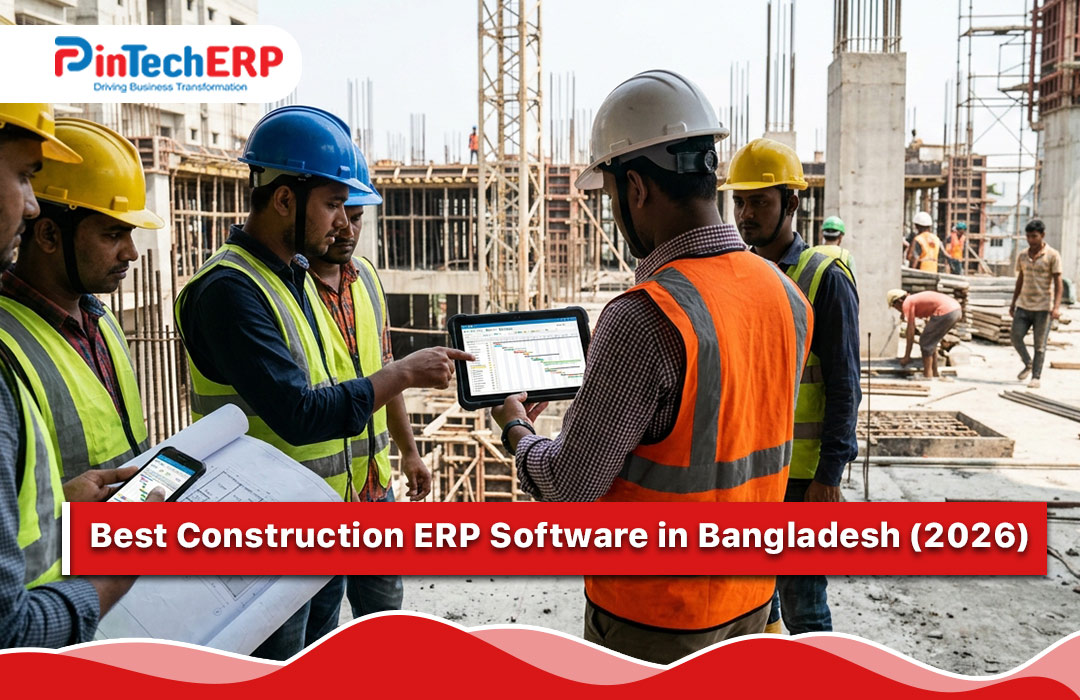
Site engineers and supervisors are rarely at a desk. The ability to log material receipts, daily progress, and labor attendance from a phone directly at the site is one of the most valuable features a modern construction ERP can offer.
Local Compliance and Reporting
Government contracts and private developer partnerships in Bangladesh often require specific reporting formats, VAT and tax compliance under NBR regulations, and documentation standards that generic international software may not handle out of the box.
Integration With Real Estate Sales (for Developer-Contractors)
Many construction firms in Bangladesh also act as developers, selling the units they build. For these companies, a construction ERP that connects directly to a real estate sales and CRM module — rather than requiring a separate system for sales — eliminates a huge amount of duplicate data entry between construction cost tracking and customer billing. This is precisely the kind of integrated approach covered in this look at ERP software for real estate companies, where sales, accounting, and project data all sit on the same platform.
Vendor Support and Local Implementation
Because construction ERP systems touch nearly every department in a company, implementation quality matters enormously. A vendor with local support, an understanding of Bangladeshi business practices, and a track record of construction-sector clients will get your team live faster and with fewer costly missteps than an international generic platform.
How PinTech ERP Supports Construction Companies
PinTech ERP’s construction-focused modules are designed around the operational reality of running projects in Bangladesh:
- Project-wise budgeting and cost control, giving management a live view of budget versus actual spend across every active project.
- Integrated procurement and inventory, tracking material movement from central stores to individual sites, with low-stock alerts to prevent work stoppages.
- Subcontractor management, including milestone-based payment tracking tied to verified work completion.
- Milestone-based client billing, supporting the retention and variation-order requirements common in both government and private contracts.
- HR and payroll, covering both salaried staff and daily wage labor across multiple sites.
- Unified accounting, so every purchase, payment, and invoice across every project rolls up automatically into accurate, audit-ready financial statements.
- For developer-contractors, a direct connection to PinTech ERP’s real estate sales and CRM modules, so construction cost and progress data can inform (and be informed by) sales and customer billing without duplicate work.
Frequently Asked Questions
Is construction ERP only useful for very large firms with dozens of projects? No. Even a firm running two or three projects at once benefits significantly from having project-wise budgets, procurement, and accounting connected, since the alternative is usually a set of disconnected spreadsheets that are hard to keep accurate as the company grows.
How is a construction ERP different from general business accounting software? General accounting software records transactions but has no concept of a project, site, or subcontractor milestone. A construction ERP builds these into its core structure, so cost tracking, procurement, and billing are all organized around the actual project, not just the chart of accounts.
Can a construction ERP handle both government and private-sector contracts? Yes, provided the system supports milestone-based billing, retention money tracking, and variation orders, all of which are common requirements across government tenders and larger private contracts alike in Bangladesh.
What’s the typical timeline to see a return on investment after adopting a construction ERP? Many firms start seeing tighter cost control and fewer billing errors within the first one to two active projects after go-live, though the full value compounds over time as historical data accumulates and planning improves.
Final Thoughts
Heading into 2026, the construction companies in Bangladesh that will scale successfully are the ones that treat cost control and real-time visibility as a core operational discipline, not an afterthought handled by an overworked accountant at month-end. A properly implemented construction ERP turns scattered spreadsheets, WhatsApp updates from site engineers, and manual reconciliation into a single, reliable source of truth for every project the company runs. For firms that also sell what they build, choosing a system that connects construction operations directly to real estate sales removes one of the biggest sources of duplicated effort and financial mismatch in the business.
If you’re evaluating construction ERP options this year, prioritize systems built with Bangladesh’s regulatory environment, project structures, and business practices in mind — not ones adapted after the fact from a generic international template.