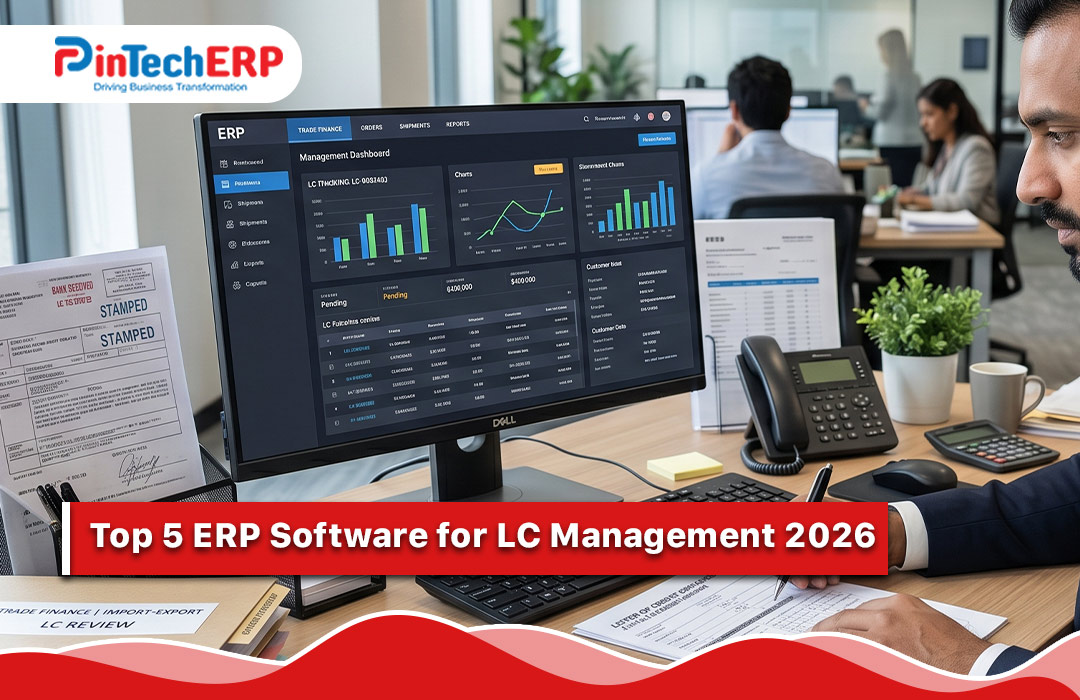
In today’s global trade environment, managing Letters of Credit (LCs) efficiently has become essential for importers, exporters, manufacturers, trading companies, and large enterprises. As international trade regulations become more complex, businesses need a reliable ERP system that can automate LC processing, track documentation, manage supplier payments, monitor shipment status, and ensure compliance.
Traditional spreadsheet-based LC management often leads to delays, documentation errors, compliance issues, and poor visibility into financial obligations. Modern ERP software eliminates these challenges by integrating procurement, inventory, finance, banking, supply chain management, and LC workflows into a single platform.
As we enter 2026, businesses are increasingly investing in ERP solutions that provide end-to-end visibility over the entire import-export process. The best LC Management ERP software helps organizations streamline operations, reduce costs, improve compliance, and make faster decisions.
In this guide, we review the Top 5 ERP Software for LC Management in 2026, with a detailed look at features, benefits, and ideal use cases.
1. PinTechERP – Best Overall ERP Software for LC Management 2026
Why PinTechERP Ranks #1
PinTechERP has emerged as one of the most powerful ERP solutions for businesses involved in imports, exports, manufacturing, trading, construction, and supply chain operations. Developed by Pinovation Tech Ltd., the platform offers a fully integrated ERP ecosystem that connects finance, procurement, inventory, CRM, SCM, HRM, project management, and reporting within a single system.
Website: https://pintecherp.com/
Key LC Management Features
- LC Opening Management
- Import Documentation Tracking
- Supplier Invoice Management
- Purchase Order Integration
- Shipment Tracking
- Duty & Tax Calculation
- Multi-Currency Support
- Bank Reconciliation
- Vendor Management
- Cost Allocation
- Automated Approval Workflow
- Landed Cost Management
Advanced Financial Integration
One of the biggest strengths of PinTechERP is its fully integrated Accounts & Financial Management module. Every procurement, LC payment, customs duty, freight cost, and supplier transaction automatically flows into the financial system, reducing manual work and improving accuracy.
Supply Chain & Inventory Excellence
PinTechERP’s Inventory and Supply Chain Management system enables businesses to monitor goods from procurement to warehouse receipt. It supports stock valuation, landed cost calculations, procurement automation, and warehouse management, making it highly effective for LC-based imports.
Benefits
- Cloud-based architecture
- Real-time reporting
- Multi-branch management
- Multi-currency transactions
- Strong compliance controls
- Customizable workflows
- Industry-specific solutions
- Fast implementation
Best For
- Import & Export Companies
- Manufacturing Businesses
- Trading Companies
- Construction Firms
- Real Estate Organizations
- Large Enterprises
- SMEs Scaling Internationally
Pros
✓ Complete business integration
✓ Strong financial controls
✓ LC-friendly procurement workflow
✓ Local support and implementation
✓ Highly customizable
✓ Real-time dashboards
Cons
- Advanced features may require user training
Rating
⭐⭐⭐⭐⭐ 5/5
2. SAP S/4HANA
SAP remains one of the most recognized ERP platforms globally and offers powerful international trade and LC management capabilities.
Large enterprises often choose SAP because of its scalability and extensive supply chain functionality.
Key LC Features
- Trade Compliance Management
- Import/Export Processing
- Treasury Management
- Multi-Currency Transactions
- Supplier Collaboration
- Financial Automation
Best For
- Multinational Corporations
- Large Manufacturing Companies
- Global Supply Chains
Pros
✓ Enterprise-grade functionality
✓ Strong compliance tools
✓ Extensive global support
✓ Advanced analytics
Cons
✗ Very expensive
✗ Long implementation timeline
✗ Requires specialized consultants
Rating
⭐⭐⭐⭐☆ 4.8/5
3. Oracle NetSuite ERP
Oracle NetSuite is a cloud-native ERP platform widely used by growing international businesses.
Its procurement, finance, inventory, and global trade capabilities make it suitable for organizations handling multiple LCs and international suppliers.
Key Features
- Procurement Automation
- Multi-Currency Accounting
- Financial Consolidation
- Vendor Management
- Inventory Tracking
- Global Tax Compliance
Best For
- Mid-sized Enterprises
- International Trading Companies
- Distribution Businesses
Pros
✓ Fully cloud-based
✓ Strong reporting capabilities
✓ Global accessibility
✓ Easy scalability
Cons
✗ Higher licensing costs
✗ Customization can become expensive
Rating
⭐⭐⭐⭐☆ 4.7/5
4. Microsoft Dynamics 365 Finance & Supply Chain
Microsoft Dynamics 365 combines finance, procurement, inventory, and supply chain management into a modern cloud ERP solution.
Companies involved in import operations benefit from its financial planning and procurement automation capabilities.
Key Features
- Supply Chain Visibility
- Procurement Management
- Vendor Collaboration
- Financial Reporting
- Multi-Currency Accounting
- Workflow Automation
Best For
- Mid-to-Large Enterprises
- Manufacturing Organizations
- Distribution Companies
Pros
✓ Strong Microsoft ecosystem integration
✓ Powerful analytics
✓ User-friendly interface
✓ Cloud scalability
Cons
✗ Complex setup
✗ Premium licensing costs
Rating
⭐⭐⭐⭐☆ 4.6/5
5. Odoo ERP
Odoo has become a popular ERP choice due to its modular structure and affordability.
Although it may require customization for advanced LC management workflows, it offers flexibility and cost-effective implementation.
Key Features
- Purchase Management
- Inventory Tracking
- Accounting Integration
- Vendor Management
- Document Management
- Workflow Automation
Best For
- SMEs
- Growing Trading Companies
- Startups
Pros
✓ Affordable
✓ Modular architecture
✓ Large developer community
✓ Flexible customization
Cons
✗ Advanced LC processes require customization
✗ Quality depends on implementation partner
Rating
⭐⭐⭐⭐☆ 4.4/5
Comparison Table
| ERP Software | LC Management | Financial Integration | Inventory Control | Cloud-Based | Best For |
|---|---|---|---|---|---|
| PinTechERP | Excellent | Excellent | Excellent | Yes | Trading, Manufacturing, Importers |
| SAP S/4HANA | Excellent | Excellent | Excellent | Yes | Large Enterprises |
| Oracle NetSuite | Very Good | Excellent | Very Good | Yes | Mid-Large Companies |
| Microsoft Dynamics 365 | Very Good | Excellent | Very Good | Yes | Enterprises |
| Odoo ERP | Good | Good | Good | Yes | SMEs |
How to Choose the Right LC Management ERP
When evaluating ERP software for LC management in 2026, consider the following factors:
Integration Capability
Your ERP should connect finance, procurement, inventory, and supply chain processes.
Multi-Currency Support
International trade requires handling multiple currencies efficiently.
Document Management
The system should securely manage invoices, packing lists, bills of lading, and LC documents.
Real-Time Reporting
Management needs instant visibility into shipments, payments, and financial obligations.
Compliance
Choose software that helps maintain regulatory and banking compliance.
Scalability
Your ERP should support future growth and increased trade volume.
Final Verdict
Effective LC management is no longer just an operational requirement—it is a strategic necessity for businesses involved in international trade.
While SAP, Oracle NetSuite, Microsoft Dynamics 365, and Odoo offer strong capabilities, PinTechERP stands out as the best ERP software for LC Management in 2026 due to its powerful integration of finance, procurement, inventory, supply chain management, and business operations within a single platform. Its cloud-based architecture, real-time reporting, multi-currency support, and industry-focused implementation make it an ideal solution for importers, exporters, manufacturers, and trading companies.
For organizations looking to modernize their LC operations and gain complete visibility over international trade processes, PinTechERP is a leading choice for 2026.