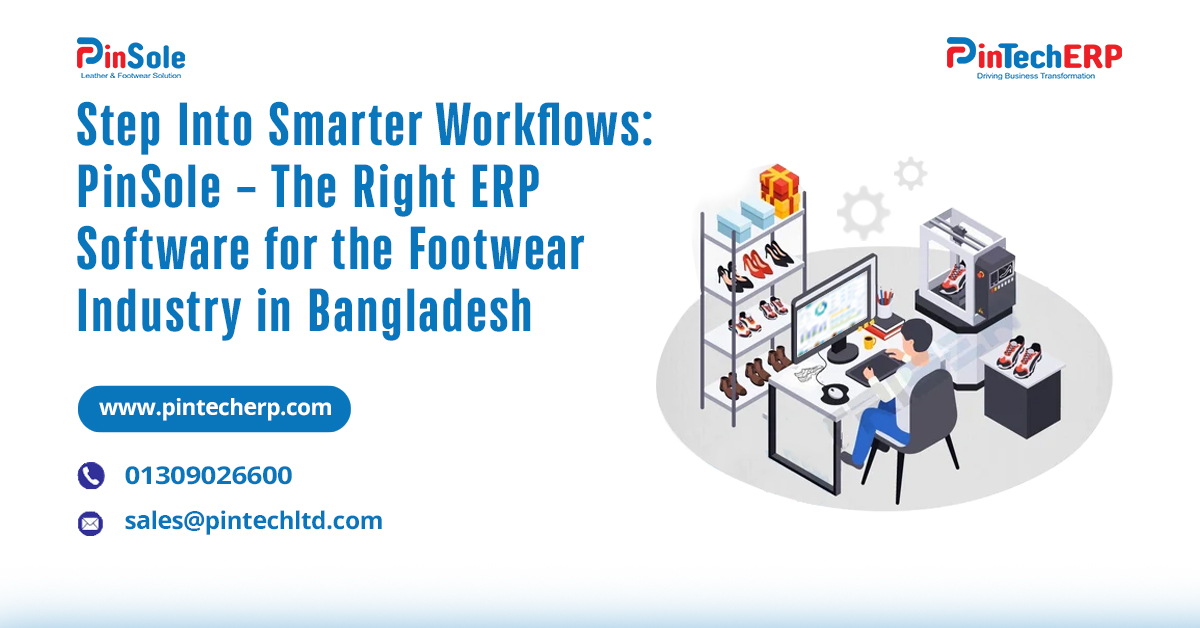
ERP software for the footwear industry connects orders, materials, size-wise production, stock, costing, accounts and delivery in one system. It helps shoe and leather factories control wastage, plan production stage by stage and know the real cost of every pair before they quote the next order.
This guide is for factory owners, production managers and merchandisers in Bangladesh who make shoes, sandals, leather goods or components, for local brands or export buyers.
Why shoe making is harder to manage than it looks
A shoe is not one product. It is a bundle of parts. A single style can have an upper, lining, insole, outsole, heel, toe cap, laces, eyelets, adhesives, threads, labels and a box. Each part comes in sizes and colors. Each size may use a different amount of material.
Then add the process. Cutting, skiving, stitching or closing, lasting, sole attaching, finishing and packing. Each stage has its own output, rejects and rework.
Common problems in factories that run on Excel and paper:
- Wrong material estimates. The BOM is built for one size and copied for others, so the purchase is off.
- High cutting waste. Nobody tracks how much leather or synthetic material is lost, or why.
- Stage confusion. The factory cannot say how many pairs are in cutting, in stitching or in finishing.
- Size and color mismatch. The order needs 200 pairs in size 41 and the factory makes 300 by mistake.
- Late deliveries. Material arrives late, or one stage becomes a bottleneck.
- Unclear cost. The quote was made on guesswork, and the margin is gone by the time the order ships.
- Stock mismatch. Leather, chemicals, soles and cartons are counted on paper once a month.
A footwear ERP gives every one of these a clear record.
What footwear ERP should include
1. Style and article master. Store each style or article with photos, last, sole type, material list and size range. Keep versions as designs change.
2. Size-wise and color-wise BOM. The BOM should work by size run, not just per style. Different sizes use different amounts of material, and the ERP should calculate this properly.
3. Order management. Record buyer orders with size-color matrices, delivery dates, packing rules and special instructions. Track each order from confirmation to shipment.
4. Material planning and purchase. From the order and BOM, the system calculates how much leather, fabric, sole, insole, adhesive, thread and packaging you need, checks stock and creates purchase requests for the shortage.
5. Leather and material handling. Leather is bought by area and grade. The ERP should handle area-based stock, grade, lot and shade, and track yield in cutting.
6. Production planning and stages. Plan by order and by stage: cutting, skiving, closing, lasting, sole attaching, finishing and packing. Set dates and capacity for each.
7. Work in progress tracking. See how many pairs are at each stage, by line, order and size. Know where the bottleneck is.
8. Wastage and rework control. Record waste at cutting and rejects at each stage. Compare actual against allowed wastage.
9. Quality control. Inspection points, defect types and rework records. Link quality data to the style, line and operator when needed.
10. Costing. Standard cost per pair, based on material, labor and overhead. Compare against actual cost after production.
11. Inventory and warehouse. Raw material, components, WIP and finished goods across stores. Batch and lot tracking where needed.
12. Packing and shipment. Carton and pair counts by size, packing lists, invoices and export documents. See also ERP for import-export.
13. Accounts, VAT and payroll. Purchase bills, sales invoices, ledgers, VAT, salary and overtime in the same system. See HR and payroll software in Bangladesh.
14. Reports. Order status, material shortage, production by stage, wastage, stock and profit by order.
Features that matter most to shoe makers
Size run logic. If the system cannot handle size-wise BOM and packing, it is not built for footwear.
Material yield tracking. For leather, even small percent changes in yield mean large money.
Component tracking. Lasts, molds and sole dies are valuable. Track where they are and who has them.
Subcontracting support. Many factories send work like stitching or sole making outside. The ERP should track material sent and received, and the charge.
Multi-branch view. If you run several factories or showrooms, you need one report across all. See smart ERP for multi-branch shoe factories.
Barcode support. Barcodes on cartons and finished pairs speed up stock counts and dispatch.
Factory, brand or both?
Footwear businesses fall into three groups, and each needs a slightly different focus.
- Export factories need buyer order control, size-color matrices, packing lists, documents and strong costing.
- Local brands with factories need production and also retail, showroom stock, POS and distribution. See PinPOS and ERP for the retail industry.
- Leather processors and component makers need lot tracking, chemicals, yield and process control. See leather ERP software.
Ask the vendor which of these they have set up before.
How footwear ERP saves money
You do not need magic numbers to see the value. Think about the real leaks in a shoe factory.
Less material waste. Better BOM and cutting records make waste visible and reduce it over time.
Fewer stock-outs and rush purchases. When material is planned from the order, you do not buy at emergency prices.
Lower excess stock. You buy what the orders need, not more.
Better pricing. With real cost per pair, you quote with confidence and know which styles pay.
On-time delivery. Seeing the bottleneck early lets you fix it before it delays shipment.
Less time on reports. The owner sees order status and stock in minutes, not days.
To estimate your own numbers, use the ERP ROI calculator.
How to choose a footwear ERP
Test with one real style. Give the vendor a style with a size run and a full material list. Ask them to set up the BOM, create an order, plan material and show a costing sheet.
Ask the hard questions.
- How does the BOM change across sizes?
- How is leather bought by area and used in cutting?
- How do I see pairs at each stage for one order?
- How do I handle outside stitching or sole attaching?
- How do I record rejects and rework?
Check reports. Order status, material shortage, WIP, wastage and order profit.
Check local fit. VAT and Mushak records, BDT, bonded or export documentation if you export, and local payroll rules.
Check support. A factory cannot wait days for a fix. Ask about response time and on-site help.
Check price and growth. Look at user, plant and module limits. See leather and footwear ERP price in Bangladesh and the general guide to ERP software price in Bangladesh.
For a full buying framework, read how to choose the right ERP software.
How to roll out in a factory
- Clean your masters. Styles, materials, suppliers, sizes and units.
- Build the BOMs. Start with your top styles, not everything at once.
- Load opening stock. Count physical stock first.
- Start with purchase, stock and costing. Then add production stages.
- Train line supervisors and store keepers. Simple, hands-on, in Bangla.
- Run in parallel for a short time. Compare system numbers with real counts.
- Add quality, subcontracting and advanced reports.
Our ERP implementation steps guide goes deeper.
Mistakes to avoid
Using a general manufacturing ERP without footwear logic. You will end up customizing size runs and leather handling from scratch.
Skipping BOM accuracy. If the BOM is wrong, every plan and cost is wrong.
No discipline in store issue. Material must be issued against orders, not taken freely.
Ignoring the shop floor. If supervisors do not enter data, WIP numbers will be false.
Customizing too much too early. Use the standard flow first.
A short example
A factory gets an order of 5,000 pairs across eight sizes and two colors. Without ERP, the merchandiser calculates material in Excel, the store checks stock on paper and the purchase team orders by phone. Halfway through, the factory runs short on a lining material for one size. Production stops for two days.
With ERP, the order creates a size-wise material requirement. Stock is checked automatically. Shortages go to purchase on day one. Production stages are planned with dates. The manager sees pairs per stage each day and can move people to the bottleneck. The order ships on time, and the costing sheet shows the real margin.
Where PinSole fits
PinSole is our ERP built for leather and footwear businesses in Bangladesh. [Add: confirm and list the real features, such as size-wise BOM, leather area stock, stage-wise WIP, subcontracting, costing and export documents. Add a named client, factory size, and a screenshot of the WIP board or costing sheet.]
See more in our guides to PinSole, the best ERP for the footwear industry, the best footwear manufacturing software and the top 5 shoe factory ERP systems. To see it with your own style and order, request a demo and bring a BOM and a size-color order.
Quick checklist
- Style master with size-wise, color-wise BOM
- Order management with size-color matrix
- Material planning from orders
- Leather area, grade and yield tracking
- Stage-wise production and WIP
- Wastage, quality and rework records
- Subcontracting control
- Costing per pair
- Stock, packing and shipment
- Accounts, VAT and payroll linked
FAQs
What is footwear ERP? It is software for shoe and leather factories that manages orders, size-wise BOM, materials, production stages, costing, stock and accounts.
Why not use a general manufacturing ERP? General systems often miss size runs, leather area stock and stage-wise shoe production, so you pay for heavy customization.
Can it track leather by area? A footwear-focused system should. Ask to see area-based stock and cutting yield in a demo.
Can it handle outside stitching or sole making? Yes, if it supports subcontracting. Check how material sent and received is tracked.
Can I use it for showrooms and retail too? With a POS and retail module, yes. See PinPOS.
How long does setup take? It depends on the number of styles and stages. Many factories start with core modules in weeks and add production stages in phases.